 ASGE
← All examples
Rendering
Shapes
Every primitive ASGE can draw
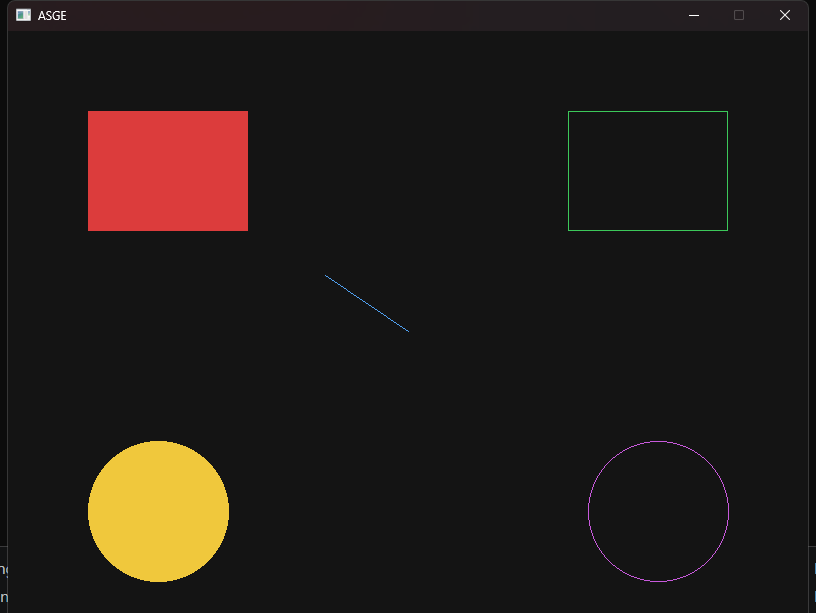
A single screen that exercises every primitive on IRenderer — filled and outlined rectangles, circles, lines and points — including a line swept through a full rotation to show angle handling.
There's no game logic here: shapes_demo exists purely as a visual reference for the rendering-primitives phase of the roadmap.
No input — purely a visual reference for this subsystem.
Run it yourself
build just this example
cmake --build --preset windows-debug --target shapes_demo
# binary lands under bin/ (e.g. bin/Debug/shapes_demo.exe on Windows)
See Installation for the full build setup.
Source
examples/shapes_demo/Game.hpp
#pragma once

#include <ASGE/ASGE.hpp>

class ShapesDemoState final : public asge::game::state::IGameState<int>
{
    float m_LineAngle{0.0f}; // Drives the sweeping DrawLine demo

public:
    [[nodiscard]] std::optional<asge::game::state::Transition<int>>
    Update(float inDeltaTime, asge::input::InputState const& inInput) override;
    void Render(asge::video::IRenderer& inRenderer) override;
    void OnSystemEvent(asge::event::SystemEvent const& inSysEvent) override;
};

class ShapesDemoGame final : public asge::game::Game<int>
{
public:
    explicit ShapesDemoGame(asge::video::IRenderer& inRenderer, asge::audio::AudioDevice& inAudioDev);

protected:
    [[nodiscard]] std::unique_ptr<StateType> CreateState(int inId) override;
};
examples/shapes_demo/Game.cpp
#include "Game.hpp"

#include <cmath>

namespace
{
constexpr float LINE_SWEEP_SPEED = 1.5f; // radians per second
constexpr float LINE_RADIUS      = 100.0f;
const asge::math::Float2 LINE_ORIGIN{ 400.0f, 300.0f };
}

std::optional<asge::game::state::Transition<int>>
ShapesDemoState::Update(float inDeltaTime, [[maybe_unused]] asge::input::InputState const& inInput)
{
    m_LineAngle += LINE_SWEEP_SPEED * inDeltaTime;
    return std::nullopt;
}

void ShapesDemoState::Render(asge::video::IRenderer &inRenderer)
{
    inRenderer.Clear({ 20, 20, 20, 255 });

    // Filled rect
    inRenderer.DrawRect(
        asge::math::Rect{ 80.0f, 80.0f, 160.0f, 120.0f },
        { 220, 60, 60, 255 },
        true
    );

    // Outlined rect
    inRenderer.DrawRect(
        asge::math::Rect{ 560.0f, 80.0f, 160.0f, 120.0f },
        { 60, 200, 90, 255 },
        false
    );

    // Sweeping line, to exercise DrawLine
    asge::math::Float2 tip{
        LINE_ORIGIN.x() + std::cos(m_LineAngle) * LINE_RADIUS,
        LINE_ORIGIN.y() + std::sin(m_LineAngle) * LINE_RADIUS
    };
    inRenderer.DrawLine(LINE_ORIGIN, tip, { 80, 160, 240, 255 });

    // Filled circle
    inRenderer.DrawCircle(
        asge::math::Int2{ 150, 480 }, 70,
        { 240, 200, 60, 255 },
        true
    );

    // Outlined circle
    inRenderer.DrawCircle(
        asge::math::Int2{ 650, 480 }, 70,
        { 200, 90, 220, 255 },
        false
    );
}

void ShapesDemoState::OnSystemEvent([[maybe_unused]] asge::event::SystemEvent const &inSysEvent)
{
}

ShapesDemoGame::ShapesDemoGame(asge::video::IRenderer& inRenderer, asge::audio::AudioDevice& inAudioDev)
: Game(inRenderer, inAudioDev)
{
    SetInitialState(0);
}

std::unique_ptr<ShapesDemoGame::StateType> ShapesDemoGame::CreateState([[maybe_unused]] int inId)
{
    return std::make_unique<ShapesDemoState>();
}